
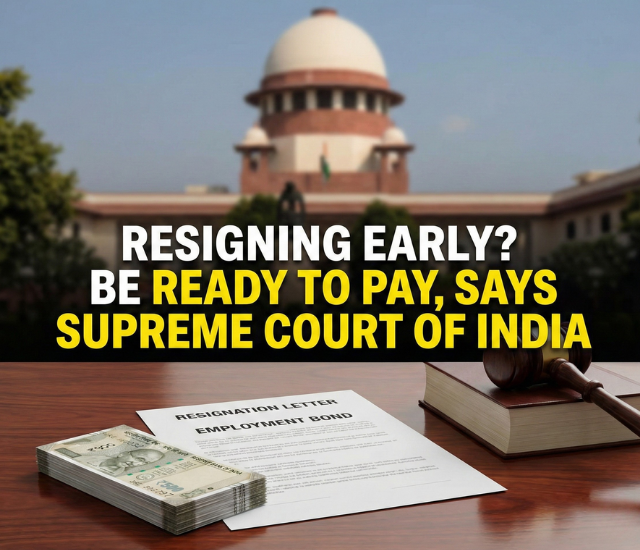
In a significant development for Indian employment law, the Supreme Court has clarified the enforceability of employment bonds in its judgment in Vijaya Bank & Anr. v. Prashant B. Narnaware, delivered in May 2025. Supreme Court upheld a clause in an Employment appointment letter requiring the employee to either serve a minimum of three years or pay ₹2,00,000 in case of early resignation. This decision provides much-needed clarity on the legal contours of employment bonds, particularly with respect to restraints on employment, compensation for early termination, and the balance between employer interests and employee rights.
Factual Background In 2007, Mr. Prashant B. Narnaware was appointed as a Senior Manager by Vijaya Bank. The appointment letter contained a clause obligating him to serve the Bank for a minimum period of three years or pay ₹2,00,000 as compensation in the event of early resignation. This clause was formalised through an indemnity bond executed by Mr. Narnaware. In July 2009, Mr. Narnaware resigned before completing the stipulated three-year tenure. He remitted the sum of ₹2,00,000 to the Bank “under protest” and subsequently approached the Karnataka High Court challenging the validity of the bond. His arguments were premised on the alleged violation of: Article 19(1)(g) of the Constitution (right to practice any profession), Section 27 of the Indian Contract Act, 1872 (restraint of trade), and Section 23 of the Indian Contract Act (agreements opposed to public policy). The High Court found merit in these submissions and directed Vijaya Bank to refund the amount. Aggrieved by this decision, the Bank preferred an appeal before the Supreme Court.
Supreme Court’s Analysis and Decision the Supreme Court reversed the High Court’s ruling and upheld the validity and enforceability of the bond clause.
The Court’s reasoning provides key insights into how employment bonds are assessed under Indian law.
1.No Restraint of Trade under Section 27 The Court held that the clause did not fall foul of Section 27 of the Indian Contract Act. A contract term that merely requires an employee to either serve for a minimum period or compensate the employer in case of early exit does not restrain trade or employment. The clause was limited in operation to the period of employment and did not prevent the employee from seeking employment elsewhere post-resignation. In the Court’s view, such clauses are permissible so long as they do not create a post-termination restriction on employment opportunities. Accordingly, the clause in question did not constitute a restraint of trade.
- Not Opposed to Public Policy under Section 23 The Supreme Court examined whether the clause could be invalidated under Section 23 as being opposed to public policy or unconscionable due to unequal bargaining power. While acknowledging that standard-form contracts and bonds of adhesion may be reviewed for fairness, the Court found no evidence that Mr. Narnaware had been coerced into signing the bond. On the contrary, the clause was: Clearly mentioned in the appointment letter, supported by an indemnity bond executed voluntarily, entered into by a managerial-level employee, and Justified by a legitimate employer interest. Vijaya Bank, as a public sector undertaking, incurs substantial expenditure in the recruitment and training of managerial staff. The clause was intended to protect that investment and encourage retention. Therefore, it did not offend public policy.
- Compensation Not in the Nature of a Penalty the Court also addressed whether the ₹2,00,000 payment constituted an unenforceable penalty under Section 74 of the Contract Act. It noted that the clause did not impose a punitive charge but was a pre-estimate of loss suffered by the employer in the event of early resignation. Such liquidated damages clauses are enforceable where the amount is reasonable and not disproportionate. In the absence of evidence showing that the figure was arbitrary or excessive, the Court found no reason to strike it down. The compensation was, in its view, a genuine pre-determined estimate and therefore enforceable.
- No Violation of Constitutional Rights The argument that the clause infringed Articles 14 and 19(1)(g) of the Constitution was also rejected. The clause did not discriminate between employees, nor did it prevent the employee from exercising his right to seek alternative employment. The obligation was contractual in nature and arose from voluntary agreement, not State-imposed restriction.
Legal Implications of the Decision
This decision significantly strengthens the enforceability of employment bonds in India provided certain conditions are met. Based on the Court’s reasoning, the following principles may be inferred:
- Employment bonds are legally valid if they are limited to the term of employment and do not restrict future employment post-resignation.
- A clause requiring repayment of training or recruitment costs is enforceable where the amount is a reasonable pre-estimate of loss or expenditure incurred.
- Employers must ensure full disclosure of such clauses at the time of appointment and secure employee acknowledgment and acceptance, preferably through a separate bond or undertaking.
- Courts will examine the proportionality and legitimacy of the bond amount, particularly in cases involving junior employees or standard-form contracts.
- Clauses that seek to enforce post-termination non-compete restrictions, however, continue to be treated as void under Section 27.
Guidance for Employers intending to enforce minimum service bonds should review their contracts to ensure the following:
The bond clause is clearly worded, specifying the minimum tenure and compensation amount. There is a demonstrable business rationale, such as high recruitment or training costs. The amount is not excessive and reflects actual or estimated loss. The employee’s consent is obtained in writing, ideally through a standalone indemnity or undertaking. Public sector organisations, in particular, may rely on this ruling to justify structured retention policies, provided they do not attempt to impose unreasonable restrictions beyond the tenure of service.
Considerations for Employees entering into employment agreements with service bonds should:
Carefully review the duration and financial terms of the bond. Seek clarification, if required, on the basis of the compensation amount. Recognise that once accepted, early resignation may trigger legal and financial consequences under the agreed terms. Be aware that courts will enforce reasonable bonds, especially where employers can show genuine loss. Conclusion The Supreme Court’s decision in Vijaya Bank v. Prashant B. Narnaware provides welcome clarity on the enforceability of employment bonds in India. It reinforces the principle that such bonds are contractually valid and enforceable, provided they are fair, limited in scope, and supported by legitimate business considerations. This ruling serves as valuable guidance for both employers and employees in structuring and assessing service bond obligations.
While employees remain free to resign and seek alternative employment, employers are entitled to reasonable safeguards to protect their investment in human capital so long as such safeguards respect the boundaries of contract and constitutional law.